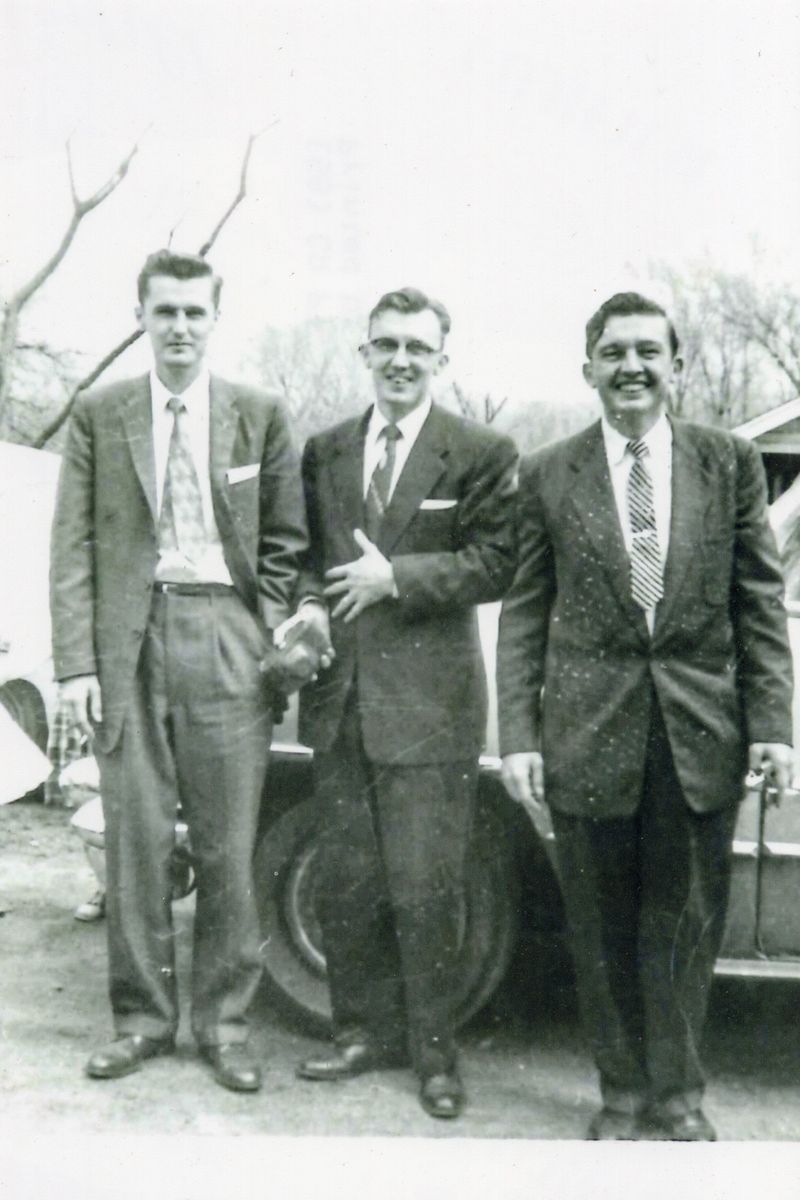
LETTERS HOME
The Wartime Correspondence of the Hanifen Brothers
A narration script for audio
PROLOGUE
There is a box.
[pause]
Maybe you've seen one like it. A shoebox, or a hatbox, or a cardboard banker's box gone soft at the corners. Inside: letters. Dozens of them. Some folded into thirds, the way the post office required. Some still in their envelopes, the two-cent stamps gone brown with age. The handwriting ranges from a father's careful pencil to a young soldier's breathless scrawl — words tumbling over each other like a man who has more to say than he has time to write.
This is the story those letters tell.
[pause]
The Hanifen family of Des Moines, Iowa. James Hanifen Senior, who ran a body and paint shop on Keo Way and wrote in pencil on shop stationery. His sons: Jim, Bob, and John. Three brothers swept up by history — by two wars, by a country in motion, by the ordinary pull of ambition and love and distance.
The letters run from 1944 to 1976. Thirty-two years. They begin with a boy fresh out of high school, mailing home from a Texas training base about gas mask drills and chicken fried steak. They end with an elderly aunt writing in a shaky hand about hair loss and calculators and dead relatives and a baby that hasn't arrived yet.
In between: everything. The atomic bomb. Post-war Italy. Korea. Dallas. Christmas hopes. Debt repayments. A son in a guard tower with a machine gun. A father shooting pheasants in Iowa and wishing his boys were home.
[pause]
They are not famous letters. The men who wrote them were not famous men. But they are real — painfully, beautifully real — and that is more than enough.
[pause]
CHAPTER ONE
Before the Storm: Des Moines, 1941–1944
Begin with the ordinary.
A driver's license, issued in Iowa in 1941. A gasoline ration book, the little coupons still inside, unclipped. A man named James Edward Hanifen Senior, running a body and paint shop in Des Moines. He owns a 1941 Plymouth. He has three sons.
The country is about to go to war.
[pause]
Des Moines in 1944 is a working-class city doing its part. Rationing. Scrap drives. Boys leaving. James Hanifen Senior watches it happen from behind the counter of Hanifen Body and Paint — first at 424 Virginia Avenue, then later at Park Street, then Keo Way. The address changes. The work doesn't. Neither does the man.
By the summer of 1944, all three of his sons are in uniform.
Jim Junior, the eldest, is at Fort Riley, Kansas, in the Cook and Baker School. John, the youngest, is coming up behind him. And Bob — Robert Edward Hanifen, the middle brother, just graduated from high school — has been swept into the Army Air Forces and shipped to the University of Wyoming for something called the Army Specialized Training Reserve Program. The ASTP. A military-academic hybrid that puts soldiers in classrooms and calls it training.
[pause]
The father writes to Jim Junior in July of 1944. The letter is in pencil. The spelling is creative. The love is unmistakable.
[pause]
"Bob starts off at 6 AM and goes right thru until 10:30 PM. In about 3 weeks, He will know he is in Hell too. I'll bet a Buck."
[pause]
He goes on.
"Bob don't get a dam penny while in school, even how to Send him Towels. And I suppose I will have to send him Soap and Toilet paper."
[pause]
There it is. The whole of wartime fatherhood in two sentences. Pride and worry wound so tight together you can't tell them apart. His boy is in Wyoming, working a sixteen-hour day, broke, and the father is mailing him soap.
He adds a warning about two other boys who got homesick and left their program early. The Army told them to go home and wait for the draft.
"Well the Kids Wouldn't have left, if they had Known that. But they Say it is really Tough in those Schools."
[pause]
It is both a caution and a comfort. Stay where you are. Tough is survivable. This is what fathers know.
[pause]
Meanwhile, Bob is writing from Laramie. His letters from the University of Wyoming have the quality of a kid who can't quite believe where he is. Room inspections. Obstacle courses. Typhoid shots. Basketball games. And somewhere twenty miles outside of town, a girl who has promised him a chicken dinner.
He writes to his father about it with complete seriousness.
[pause]
"She is going to have chicken for dinner. God help her if she don't. I have had chicken only 3 times since I left home."
[pause]
He is eighteen years old. He has been eating Army food for weeks. The chicken matters enormously.
The schedule he describes is relentless. English, then math, then physics lab, then military class, then physical training, then lights out. The high altitude, he reports, makes you sleepy all the time. He got stomach trouble from eating cantaloupe. He played two quarters of basketball and is exhausted.
And somewhere in all of that — between the ear corn and the mandatory inspections and the rigid personal review — he is becoming something. He doesn't know what yet. But something.
[pause]
The ASTP program won't last. When the Army needs bodies more than it needs trained technicians, the program winds down and the boys flow back into the standard pipeline. Bob Hanifen, recent high school graduate, is about to meet basic training.
[pause]
CHAPTER TWO
The Long Road to Nowhere in Particular: Basic Training, 1944–1945
Sheppard Field, Texas. The summer of 1944 bleeding into 1945.
Bob Hanifen's letters from basic training are long and detailed and alive. He writes the way he talks — fast, warm, everything tumbling forward. The food, the weather, the boys in the barracks, the girls in town. He goes through the gas chamber. He bivouacs. He qualifies on the carbine and the .45. And he gets his wisdom teeth out.
That last one deserves a moment.
[pause]
He writes to his father from Chanute Field in Illinois, describing what can only be called an ordeal.
"He numbed the gum, got a knife, tooth pullers, chisels, everything you can think of. He really went in — about 20 min of cutting, chiseling, pulling — he had it out and the extra one on top of that. You should see me all swelled up on one side."
[pause]
He adds, with characteristic understatement: *"It didn't hurt too bad, but it sure scared Hell out of me."*
[pause]
The dentist tells him he'll pull the other wisdom tooth in ten days. Same situation. Bob has to go to school that night and wonders if it'll hurt too much to eat. He signs off: *"Your Loving Son, Bobby."*
Twenty years old. Two wisdom teeth pulled. School that night. And still signing himself Bobby.
[pause]
Through all of this, Bob is being shuffled. The Army in 1945 is a machine that doesn't quite know what to do with itself. The training pipelines were built for a war that is now ending faster than anyone expected. Bob trains as a teletype operator. Then he's told to be a sheet metal worker. Then he's Air Corps unassigned. Each reassignment means a new base, new barracks, new buddies, new paperwork, and another letter home.
He takes it with remarkable equanimity. The frustration is there, but so is the humor. At Fort Leavenworth in April of 1945, he writes from the Service Club:
"Well the army life is just what they say it is, just what they make it. We get up at 4:30 in morning, mess around a while then do a little detail. All we did today was pick up a few cigarette butts and sleep."
[pause]
Then a line that stops you cold.
"No dance tonight on account of the president's death. Sure hated to hear about it."
[pause]
Franklin Roosevelt died on April 12th, 1945. Bob Hanifen heard about it at Fort Leavenworth, Kansas, and wrote it down between a note about tetanus shots and a question about his brother Jim. That is how history arrives for ordinary people. Not in headlines. In the cancellation of a dance.
[pause]
By midsummer, Bob is at Chanute Field in Illinois, learning sheet metal work on aircraft. Plexiglas repair. How to fix bullet holes. The war in Europe is over. The war in the Pacific is grinding toward something — though no one knows what.
And then, on a Thursday in August of 1945, Bob writes his father a short letter.
[pause]
"This new bomb might get me home a little quicker I hope. But I don't know."
[pause]
He doesn't name it. He calls it "this new bomb." He is writing on August 9th, 1945 — the day the second atomic bomb fell on Nagasaki. The next morning, he adds a line.
"Just heard about the Japs wanting to surrender. Hope they do."
[pause]
That's it. That's the whole of World War Two's ending, as seen from Chanute Field, Illinois, by a twenty-year-old kid from Des Moines. Two sentences. Then he mentions the weekend. He wants to get home the week after next. He wonders what the war ending will mean for him.
"I don't know what I will do. Probably will get 2 years in the Islands as occupation army. Sure hope not."
[pause]
He won't go to the Islands. But he isn't going home either.
Not yet.
[pause]
He finishes his sheet metal course. He processes through Greensboro, North Carolina. He reports to Camp Kilmer, New Jersey. And in February of 1946 — six months after the war ended — Private First Class Robert Edward Hanifen boards a troopship called the SS NYU Victory, and sails for Italy.
[pause]
He mails home the ship's daily newspaper — the mimeographed bulletin the soldiers printed on board. With it, a handwritten voyage log. Latitude and longitude, noon positions, distances, wind and sea conditions. Eleven days from New York to Naples. Four thousand, three hundred and thirty-one miles.
At the bottom, in Bob's handwriting, four words.
"Keep this for me. Bobby."
[pause]
CHAPTER THREE
Post-War Italy: An Ordnance Inspector in a Broken Country, 1946
He arrives February 19th, 1946.
ARRIVAL, NAPLES, ITALY: 19 February, 1300 hours.
[pause]
He is twenty years old. He has never been outside the United States. He speaks no Italian, though he's working on it. He calls it "Dego" in his letters, with the casual ignorance of his era. He calls the Italian people "Ginnies." He means no particular malice. He just grew up in Des Moines, and this is how the world looked from there in 1946.
What saves these letters from becoming merely a period document is that Bob is genuinely curious. He is watching. He is writing it all down.
[pause]
His job is ordnance inspector. He works under a Lieutenant Davidson — a former pilot, whom he describes as "a swell guy." Their task is to move through the motor pools and depots of post-war southern Italy, inspecting vehicles: jeeps, trucks, prime movers. Filing reports. Keeping the occupation machinery running.
It suits him. He has grown up around his father's body shop. He knows vehicles.
He writes to his father on February 28th, just over a week after arriving.
[pause]
"Yesterday we inspected a German Prison Camp No. 2. At this camp, which is a large Motor Pool, we look at 10% of them — they have about 226 trucks there, God knows how many jeeps. These Germans drive and repair this equipment. If it wasn't for them I don't know what this Depot would do. They do all the work there and in fact all over the place. They are smart as hell."
[pause]
The irony is not lost on him, exactly, though he doesn't name it as irony. German prisoners of war are keeping the American occupation running. The defeated are serving the victors. And the young man from Iowa is taking notes.
He goes on. He has been to the Red Cross Club in Caserta. He met an Austrian woman who speaks five languages but not English. Her brother was killed by the Germans. She and her sister fled Yugoslavia. They work at a film plant for thirty-four dollars a month. The week before, someone stole everything they owned.
Then this:
"You can get anything done here for a cigarette. I got a German to sharpen and polish my M3 knife. Give him a smoke and he will be your man for anything. They salute us all the time. What a life."
[pause]
What a life. He means it as a kind of wonder. The economy of cigarettes. The reversals of power. The strange position of being the occupier rather than the occupied. He is not proud of it, exactly. He is just describing what he sees.
[pause]
By March, Bob has settled into a rhythm. He and the Lieutenant do their inspections, drive their jeep, shoot .45s for recreation. He sends home almost every dollar he earns. His requests from home are modest: 620 camera film. His swimming trunks. The sports pages from the Drake Relays back in Iowa.
He writes on March 22nd:
"I might go to Rome this week with a convoy just to see Rome, Leghorn, Pisa and the big cities of North Italy. The jeep is still running good."
[pause]
And then, quietly, almost in passing:
"This Russian situation don't look too good to me, as we are in the hot spot right here. I was playing catch with the Lt. yesterday."
[pause]
That juxtaposition tells you everything about being twenty years old in post-war Europe. The Cold War is beginning. The geopolitical situation is genuinely alarming to a young soldier who understands, dimly but correctly, that southern Italy is not a quiet backwater. And in the same breath: he was playing catch yesterday. Life goes on.
[pause]
He meets a girl. He mentions it almost guiltily, knowing his father will worry.
"Her name is Anna. She is really nice compared to this other woman, mainly because she is clean — well, clean anyway. All the boys think she is alright. I am not going to get married, so don't worry. Just somebody to dance — remember the song."
[pause]
Naples, he reports, has been placed off-limits. Too much VD, says the Army.
"This country is all closed up. Don't work at all in the afternoon, just sit around and talk all day. Not a bad life at all. Sorta wish there was more work to do. All the boys are sitting here bulling about the girls back home. That's all we do at night it seems, besides go to the show."
[pause]
And then comes June.
[pause]
Bob has been assigned to haul equipment to the docks at Naples — a ninety-foot float. All day for one trip down and back. On June 19th, he writes to his father.
The German prisoners have gone on strike. They want more food. Bob is assigned to stand guard over them — in a tower, sixty feet up, with a machine gun.
*"None of them boys to go away,"* he writes, with something between a joke and a statement of fact.
They go back to work that afternoon.
[pause]
Then he describes coming back through Naples with his float. It's seven in the evening. The street is full of people. Two thousand of them, he estimates.
"I didn't know what to do exactly, so I asked the German. He handed me my 45 pistol. I said not yet, and put my tractor in 3rd and started plowing through. Them ginnies were pumping for their lives."
[pause]
At ten o'clock that same night, there is a riot. Fourteen people killed. Eight police.
Bob reports this and moves on. He mentions some family news. He encloses a fifty-nine-dollar money order. He signs off: *"Lots of Love, Your Son, Bobby."*
[pause]
He has been in Italy four months. He has witnessed a man shot through the chest with a .45. He has driven a ninety-foot rig through two thousand people. He has stood guard over German prisoners with a machine gun. He has learned a smattering of Italian. He has eaten badly and slept in Army bunks and sent almost every penny home.
And he is still signing himself Bobby.
[pause]
By mid-1946, the letters from Italy slow, and then stop. Bob Hanifen is coming home.
But not to Des Moines.
[pause]
CHAPTER FOUR
Dallas: Starting Over in a Hot, Dry City, 1946–1952
He ends up in Dallas, Texas.
[pause]
We don't know exactly why. The letters don't explain it. Maybe it was the warmth. Maybe it was a buddy from the service. Maybe Des Moines felt too small after Naples. Maybe he just kept moving south and stopped when he hit Texas.
By 1951, he is living at 3614 Noble Street, Dallas. He has a job at The Texas Company — Texaco — selling gasoline and Havoline motor oil. He has a woman named Jan, who signs herself "your sister, almost" in a November letter. He has a 1946 Chrysler that, he admits, isn't worth a good damn.
[pause]
He writes to his brother John about the new job with characteristic self-deprecation.
"I now work for Texaco gasoline making $206.50 a month. Not bad for a nut like me."
[pause]
There is a gap between the man who once plowed through Neapolitan crowds in a ninety-foot float and the man selling Havoline in a Dallas drought. But he is finding his way. He and Jan are building something slowly, the way young couples do — paycheck to paycheck, with a cat that tears up the house.
[pause]
Meanwhile, across the Pacific, a different Hanifen brother is in a different war.
[pause]
John Hanifen is in Korea with the 439th Engineer Construction Battalion. Repairing bridges and roads and railroads in a country that has been torn apart. Bob doesn't know the details. He knows what the newspapers tell him, what his father writes, and the occasional letter that makes it through from John's APO address in San Francisco.
He reads the newspaper one morning in May of 1952 and sees something that makes him put down his coffee.
[pause]
Communist guerrillas have ambushed American soldiers near Pusan. Five or six men. Two or three killed.
He sits down and writes to his brother.
[pause]
"Say, the paper says the Communist guerrillas ambushed about 5 or 6 GIs just outside of Pusan and killed two or three of them. So I think you had better pick up the gun and keep a sharp lookout for those rotten bastards."
[pause]
It is the most fundamental thing a brother can say. Be careful. Watch your back. I read something in the paper and it scared me and I don't know what else to do but write it down and mail it to you.
He goes on. He's been fishing at a local Dallas lake and caught a six-ounce perch. Not like the time the three of them — Bob and John and their father — went to the Crow Wing Lakes in Minnesota. The Indianapolis 500 is coming up. Their dad is in Canada trying to catch something big enough to hang on the wall at the shop.
[pause]
Then the letter turns sharp.
He has been thinking about the draft boards. About the men sitting at home while John is in Korea.
"These chicken shit draft boards have deferred everybody with a pimple on their butt. If I was you I would tell that draft board in Des Moines to kiss your ass. Every time I see these guys in the reserve or National Guard — 21 years old, married and deferred — I get pissed off."
[pause]
There it is. The genuine rage of a man who has served, watching men who haven't. His brother is in Korea. Their father is a World War One veteran. And somewhere in Dallas, a twenty-one-year-old with a deferment is going about his day.
He closes with encouragement.
"You keep up the good work and try and beat the old man's rank of Sergeant."
[pause]
Then, after his signature, a postscript. Four words.
"Keep your eyes open for those sneaking red bastards."
[pause]
It is crude. It is of its time. And it is the voice of a brother who is genuinely afraid for the person he is writing to, and doesn't know any other way to say it.
[pause]
Back in Des Moines, their father is writing his own letters to John. They come in pencil, on body shop stationery, full of news from home.
The Republican National Convention. Eisenhower. The steel strike. Pheasant season. An elk and a deer that Dick and Dad brought back — so there's a little meat on hand.
In July of 1952, he reports on the conventions with a dry humor that is entirely his own.
"This is the Day, The Republicans and Eisenhower are Shouting. If you got any Bitching to do, Put it in the Letter. Love Dad."
[pause]
He mentions, in passing, that it was Father's Day recently. Jim bought John a nice white sport shirt. Dad got a box of cigars.
"Not even a card from Bob. Doing pretty good, don't you think."
[pause]
Bob, for his part, seems to have no idea he has committed this offense. He writes to John in July with cheerful brotherly teasing.
"What are you doing in Korea, running the war all by yourself? You have been there long enough."
[pause]
He tells John about the Dallas drought. Two months without rain. He's still at the Texas Company, still selling Havoline. He has a practical suggestion.
"I was reading the papers the other day and it says all GIs in Korea are eligible for the GI Bill of Rights. You should go to Iowa University for a semester. Would do you some good, and you could also have a lot of fun."
[pause]
He encloses a clipping from a Des Moines newspaper. A stock car race at Pioneer Raceways. Lew Jenkins over Wayne Chadwick. He adds a line underneath: *"Sure glad Lew beat Chadwick."*
[pause]
This is what love looks like across eight thousand miles. A newspaper clipping. A race result. A reminder that home is still there, still running stock car races on summer evenings, still keeping score.
[pause]
The Korean War chapter of the Hanifen story has one more dark note. In mid-1952, John faces a court martial. The records don't tell us exactly what happened. But the order is there in the collection, clinical and final: John's grade is reduced. From Corporal to Private E-2. Sixty-five dollars a month forfeited for three months.
[pause]
Bob has urged him to make Sergeant. Their father has urged him to hold onto his money. And instead, John has been broken back to Private in a war that the country is already tired of.
He survives it. He comes home. A letter forwarded to the Park Street address in Des Moines suggests John has rotated back to the States by late summer. The war, for the Hanifens, is ending the way wars do for ordinary families. Not with ceremony. With a forwarding address.
[pause]
CHAPTER FIVE
Jim's Letter: February 1946
We should pause here for Jim.
Jim Hanifen Junior — the eldest of the three brothers — is the most elusive figure in this collection. He served in World War Two. By February of 1946, he is processing out of the Army at Bethany, Missouri.
He writes one letter that has survived.
[pause]
It is to his father. It is short. It is the most emotionally raw document in the entire collection.
[pause]
Something has gone wrong on the road. There was a car trouble on Route 50 — oil lost, a drain plug left loose somewhere at Roy Gordon's, it seems. The details are incomplete. What is complete is the feeling.
"I don't know quite why, but I know I have really screwed the works up."
[pause]
"It wouldn't be so bad, but I wanted to carry through a deal like this just to show you I could. But I didn't."
[pause]
And then:
"I'm a big kid now. But right now I feel like crying."
[pause]
He has survived whatever the war threw at him. He is getting out of the Army. And he has disappointed his father over a car on a Missouri highway, and it has broken something open in him.
"I'll get back to camp on time, but it won't mean a damn thing now."
[pause]
"I really am very sorry. Jim."
[pause]
There is no record of how the father responded. There is no record of what the father thought. What we know is that the letter was kept. For thirty years and more, someone kept it.
That is its own kind of answer.
[pause]
CHAPTER SIX
The Years Between: Aging Into America, 1952–1976
The collection thins after Korea.
There is a 1954 document about the Warnock estate. An Iowa farm family's legal affairs, the three Hanifen brothers listed as heirs of someone named Ollie Miller. A reminder that these men are rooted in something larger than military service — an extended network of Iowa farm families, aunts and uncles and cousins, a whole world of people who knew their parents and their grandparents.
But the letters themselves grow sparse. Bob is in Dallas, building a life with Jan. John is back in Iowa, or perhaps elsewhere — the trail goes cold. Jim is somewhere. Their father is getting older, the body shop still running, the pheasant seasons still coming.
[pause]
The 1950s pass. The 1960s pass. The boys — men now, middle-aged men — scatter further. Children arrive. Bob and Jan have a family. There are photographs in the collection that aunts haven't seen. Children the uncles haven't met.
The letters that survive from these years carry the weight of separation. Christmas hopes. The wish to come home. The acknowledgment that coming home keeps getting harder.
[pause]
And then, in May of 1976, a letter arrives in Dallas.
[pause]
It is from Aunt Pauline. Pauline F. Hanifen. She is writing to Bob, her nephew, to send him what she calls "a few treasures."
Family keepsakes. Things she has been holding onto. Things that belong to him.
[pause]
The letter is written in a hand that has gotten shakier. She apologizes for this at the end, with a humor that is both self-deprecating and a little sad — she says Pearl Miller's scribble is probably better than hers.
[pause]
She reports on her health.
"The medicine to help my bones from degenerating has caused me to lose over half of my hair. It is very thin and I have had to go to a couple of new doctors and each one wants this and that test."
[pause]
She reports on the family.
One of Bob's children is receiving a diploma this week. She is proud.
The twins — she worries about the twins. Young Jimmy hinted at something. She hopes they haven't ruined themselves.
A woman named Edith has died. Young Jimmy called when it happened, which apparently surprised people. Doris "still acts like a nut," says Pauline. "Like always. Sappy."
[pause]
The Barquist boys: Tom turned sixteen. Bobby must be about twenty-four by now.
Ann's second baby is overdue. Almost a month late.
[pause]
Someone named Marcus has had a terrible year. Winds have ripped four sets of his fishing nets — and this is the first year the fish market price has been good.
"He is sure health-wise bad,"* Pauline writes. *"His blood pressure is very low, but still able to gad about."
[pause]
Then she closes with the keepsakes. The few treasures. She signs herself Aunt P. F. Hanifen, and then adds her last name separately — she'd better, she says, in case Pearl Miller's letter arrives first and causes confusion.
[pause]
It is a letter from old age. From the far shore of a very long life.
Hair loss and calculators. Dead relatives and overdue babies. Destroyed fishing nets and a car sold for two hundred and seventy-five dollars that she can't account for.
And underneath all of it: the same warmth. The same intimacy. The same sense that the family is still there, still in contact, still writing to each other across the distances.
"All my love. Aunt P. F. Hanifen."
[pause]
EPILOGUE
Letters Home
It is thirty-two years from Bob Hanifen's first letter at Sheppard Field to Aunt Pauline's letter about her hair.
[pause]
In between: a world changed almost beyond recognition.
The atomic age began while Bob was at Chanute Field, learning to patch bullet holes in aircraft. The Cold War he worried about from Italy — *this Russian situation don't look too good to me* — lasted another forty years. The Korean War that took John ended in a ceasefire that is technically still in effect. The America that James Hanifen Senior drove his 1941 Plymouth through became something he could not have imagined.
[pause]
And yet.
A father writes to his son in pencil about pheasant season and elk hunting and the steel strike and Eisenhower shouting. A soldier drives a ninety-foot float through two thousand Neapolitan people and mails home a fifty-nine-dollar money order. A boy eats cantaloupe and gets stomach trouble and plays basketball in the thin Wyoming air and looks forward to a chicken dinner twenty miles out. A brother reads a newspaper in Dallas and is frightened, and the only thing he knows to do is write it down and mail it across the Pacific.
Keep your eyes open for those sneaking red bastards.
Not bad for a nut like me.
God help her if she don't.
I'm a big kid now. But right now I feel like crying.
[pause]
These are the letters that were kept. Saved from wastebaskets and moving boxes and the slow entropy of ordinary life. Saved because someone understood, even at the time, that they were worth saving.
[pause]
Bob Hanifen wrote from the SS NYU Victory, sailing toward a post-war Italy he had never seen, four thousand three hundred and thirty-one miles from New York:
Keep this for me.
[pause]
Someone did.
[pause]
For thirty years and more, someone kept the voyage log and the ship's newspaper and the letters from basic training and the money order receipts and the court martial order and the father's penciled notes and the aunt's shaky handwriting. Kept them the way you keep things that matter — not because you can explain why, but because you understand, in some wordless way, that losing them would be losing something that cannot be replaced.
[pause]
The Hanifen family of Des Moines, Iowa. Working-class Iowans scattered by history, held together by letters. By the faith that writing things down matters. By the conviction that someone, somewhere, will read what you wrote and know that you were real.
[pause]
They were.
[pause]
They were real.
[long pause]
End.
"Letters Home: The Wartime Correspondence of the Hanifen Brothers"